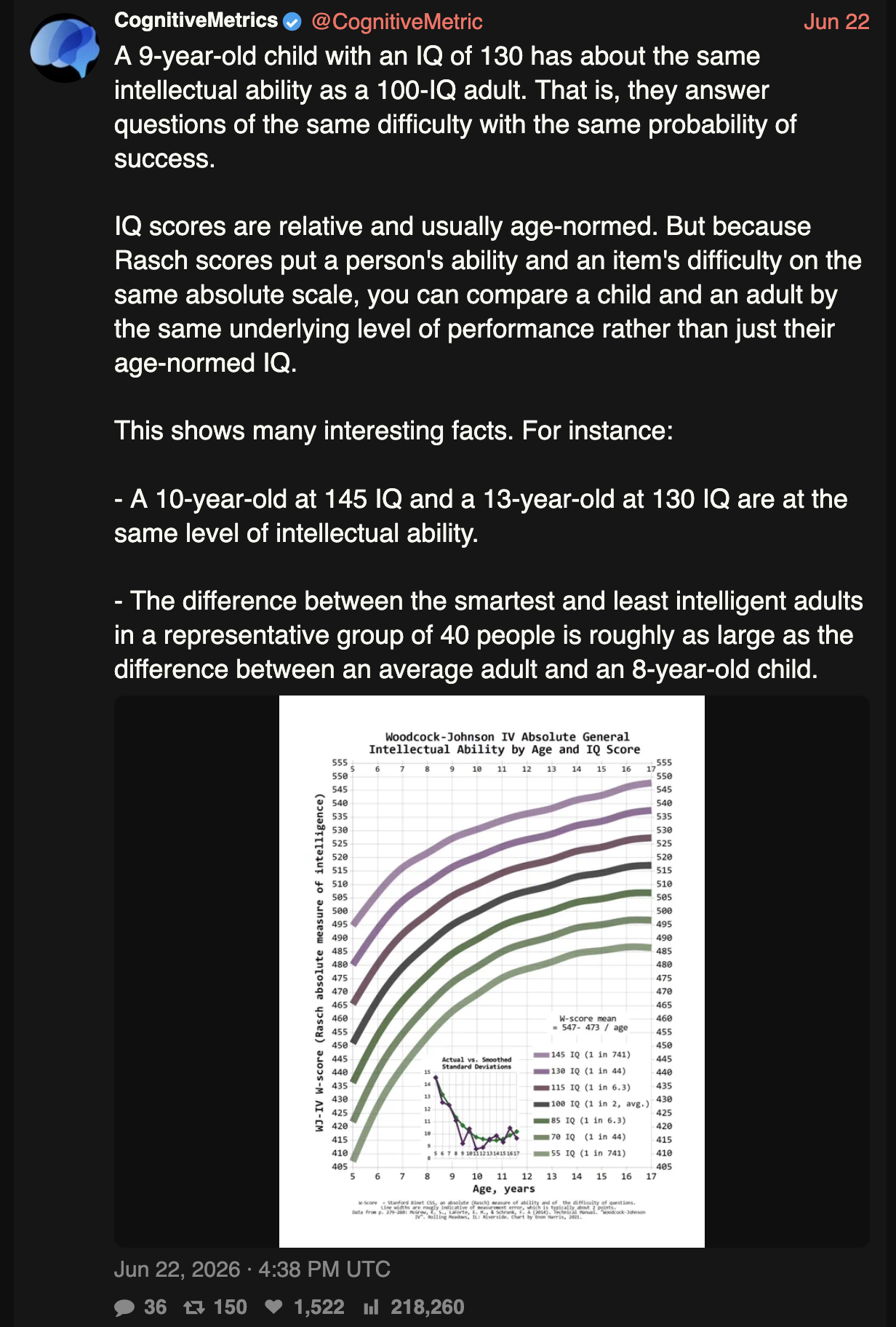
Good post, but respectfully, I don’t think IQ, the measure of capacity for cognitive complexity, is the measure of “adulthood.” The g factor is a real and important dimension, but it is a dimension, not the whole space. As Cremieux has pointed out, a person with an IQ of 70 who just lies on the left of a low-mean population distribution is quite obviously different from an “intellectually disabled” person with the same IQ score. One is visibly capable of much more even if they’d both fill out the Woodcock-Johnson the same way. I think it’s just as obvious that a child is not mentally equivalent to an adult who’d get as many questions on the Woodcock-Johnson right.
The child’s g is operating on a brain that is still under construction in dimensions g doesn’t measure. A bright 12-year-old can genuinely out-reason the adults around him on a nonfiction book and still have the limited perspective and impulse-regulation architecture of a 12-year-old, because those are different systems maturing on different timelines. I recall even you admitted on an X account that you would’ve fallen for foolish ideologies at 15, and that doesn’t mean you’re not bright; it’s normal for bright adolescents to hold overconfident limited-perspective beliefs that they cringe at in hindsight. People involved in gifted special education speak of “asynchronous development” - some children who score gifted on cognitive measures are not developmentally more “mature” than their peers but in fact unusually childish in some areas and need extra support to reach age-appropriate levels to avoid underachieving. Of course, the majority of gifted people do well in life and they have mental health issues at a lower rate than the general population, but the existence of the twice-exceptional population demonstrates that you can’t just use measures of g as all-purpose measures of “maturity.” A child can have genuinely exceptional g alongside a developmental disability that impairs exactly the executive, emotional, or social functions that adulthood asks for; if g were maturity, the twice-exceptional profile would be impossible.
It’s worth noting that even societies that recognized adulthood sooner recognized that chronological aging indicated “wisdom” that even the brightest young people lack. Although they didn’t put it in these terms, domain-specific crystallized knowledge (which is a huge component of “expert” cognition), the compiled social and practical knowledge that only experience builds, and “integration of affect with deliberation” are essential components of maturation, and these take time to grow no matter how bright one is. Ancient Rome recognized adulthood at 15, but it recognized a distinction between minores viginti quinque annis (“those lesser than 25 years”) and majores viginti quinque annis (“those greater than 25 years”), with lending heavily discouraged for the former. The American Founders set 35 as the minimum for a president not because they didn’t believe bright 17 year olds were really adults but because knowing a lot was essential for high-stakes multifactorial decision-making in proper perspective, and that grows with time.
The slide from “equal performance on the latent ability dimension” to “equal mental functioning” to “equal claim on adulthood” is a reconceptualization that nobody’s really thought of but you, not even the people who’ve developed IQ tests or done serious work in psychometrics longer than you’ve been alive, and while I agree with you that 18-as-adult is too high and many youth could be working toward their potential much sooner, I don’t agree with you there. Saying a child and an adult scoring the same have “the same mental age” is true only if you define mental age as exactly what the test measures, which isn’t any kind of qualitative insight, just circular reasoning.