Very often, one arrives at the page “notion” before reaching “philosophy”. You can skip “Greek” or “Latin,” and, for example, starting from “science,” arrive at “knowledge,” then “concept,” then “philosophy.” Starting, more anecdotally, with “butter,” and still skipping the pages referring to languages, I eventually arrive at the same result. We notice that we move each time from the specific to the fundamental. For example, I went through “milk,” then “liquid,” then “state of matter.” That said, it was mainly intended as an illustration and does not apply to all languages — it does apply to mine, which is French (just so you know, I translated the pages cited earlier).
The word “philosopher” was first used by Pythagoras to describe himself, and many ancient philosophers, such as Plato and Aristotle, founded their academies. Now, if you focus on practice, there are surely real differences between ancient and modern philosophy. You will notice that I did not say that philosophy departments ought to be funded — quite the contrary. I see philosophy as a form of entertainment, in the same way as art, but that is also what gives both their nobility.
If you dislike verbal justifications, simply be a deflationist. That is a position discussed within philosophy. You may refuse to call it philosophical, but that’s not a big deal. All these positions, and their formulations, allow us to categorize — and therefore clarify — our thinking and our concepts. And I think it is useful to argue about these positions rather than to treat them as obviously true, because first, it stimulates our critical thinking, as suggested by the study I shared.
Or to illustrate, see the discussion in this video: https://youtu.be/6p_MJhIZuhY
And second, for the sake of persuasion — if we accepts that memetics has a non-zero effect, however small.
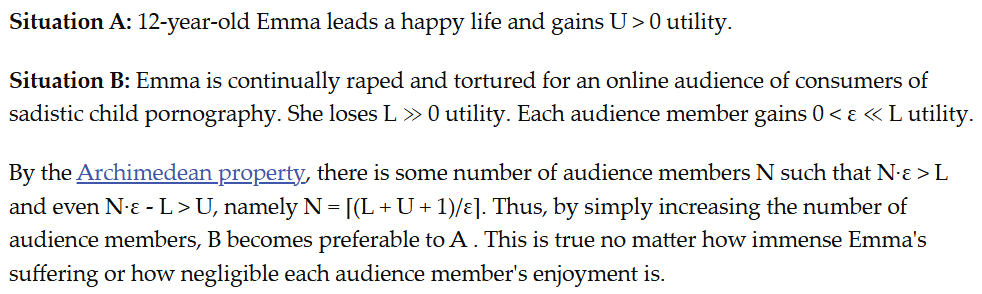
On the practical approach with regard to eugenics, I agree — but do you have examples of ethical dilemmas or reflections that would not be useful? For my part, when asked why eugenics might be a good thing, I can argue that it is because it would promote our flourishing, and that happiness is positive. I can then illustrate why, and criticize the view that suffering is good or gives life meaning through various arguments. What is the problem with this approach? Simply saying “economic growth is good” or “having good genes is good” can be viewed as superficial. If someone disagree, do you just stop there, and call them stupid? That’s not really civilized. As for moral dilemmas, I see them as interesting defeaters against ethical frameworks such as utilitarianism.
See, for example, the sadistic theater thought experiment.